Application · Realtime Droplet Inspection, Fraunhofer IIS/EAS Dresden
Training data in, real-time correction out.
A research pipeline at Fraunhofer IIS/EAS Dresden pairs two HSCAM products: a STREAMER camera, backlit through precision optics, watches the whole droplet path and builds the labelled image set an AI needs to learn what a good droplet looks like. An HSCAM NANO unit then closes the loop — classifying droplets on-chip and correcting the dispensing valve in real time.
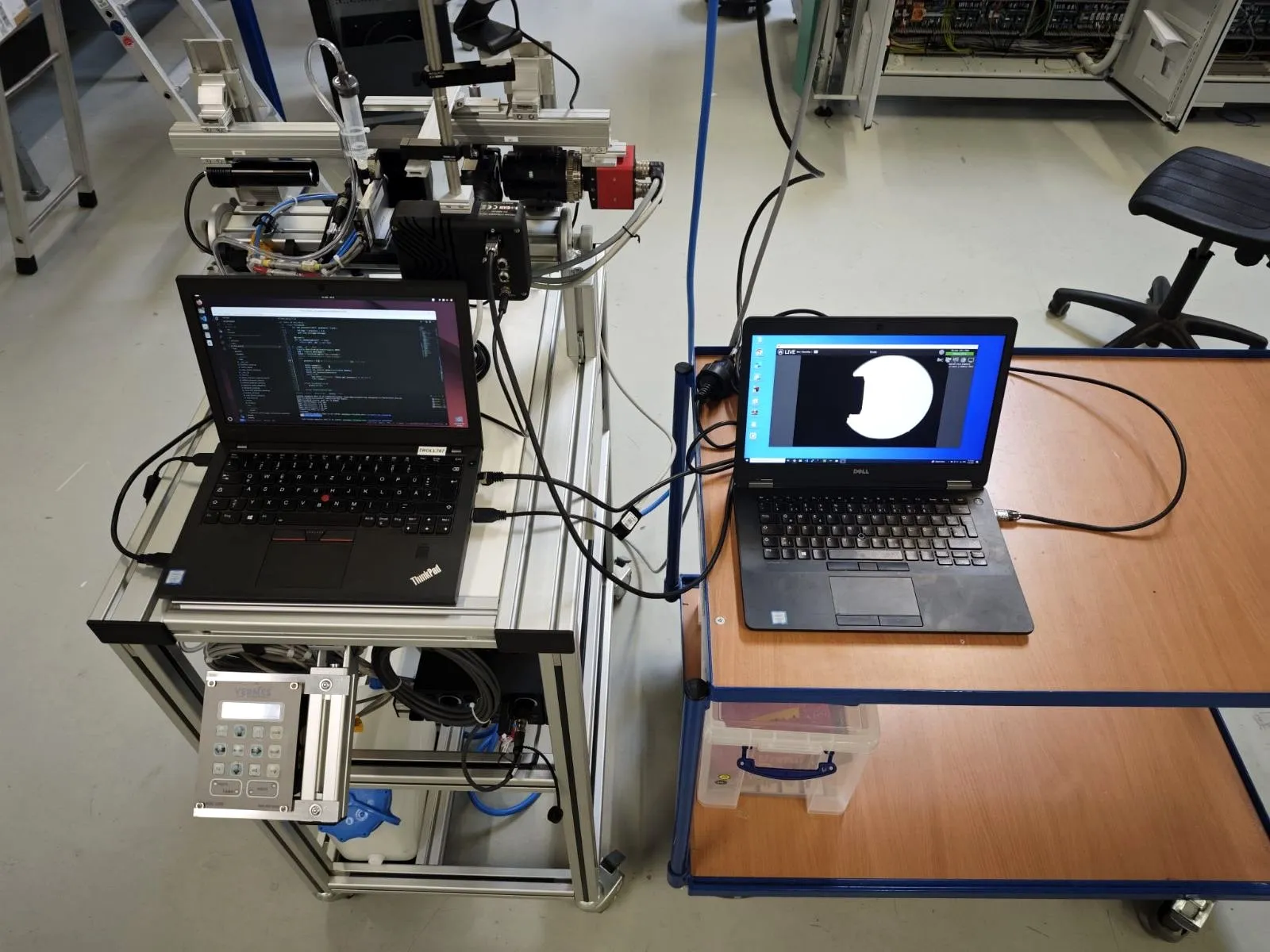 Research application — Fraunhofer IIS/EAS Dresden
 Why this exists
Learn it, then act on it fast enough to matter
A machine-vision AI that will monitor paint or coating droplets — flagging a missing droplet, a misshapen one, or a satellite spray — first has to be trained on a large number of clear, correctly labelled example images. That's the first half of this pipeline.
A trained model is only useful if the inspection runs fast enough to fix the problem before the next droplet, not just log it for later. That's the second half: on-chip classification with an output that adjusts the droplet generator directly — a closed loop, not just a monitor.
Half one — STREAMER
A camera, a beam-splitter, and a single droplet
A compact HSCAM STREAMER camera looks through a beam-splitter cube along the same axis as a backlight, so each droplet from the dispensing valve appears as a sharp, high-contrast silhouette — the clearest possible image to label by hand or feed to a model.
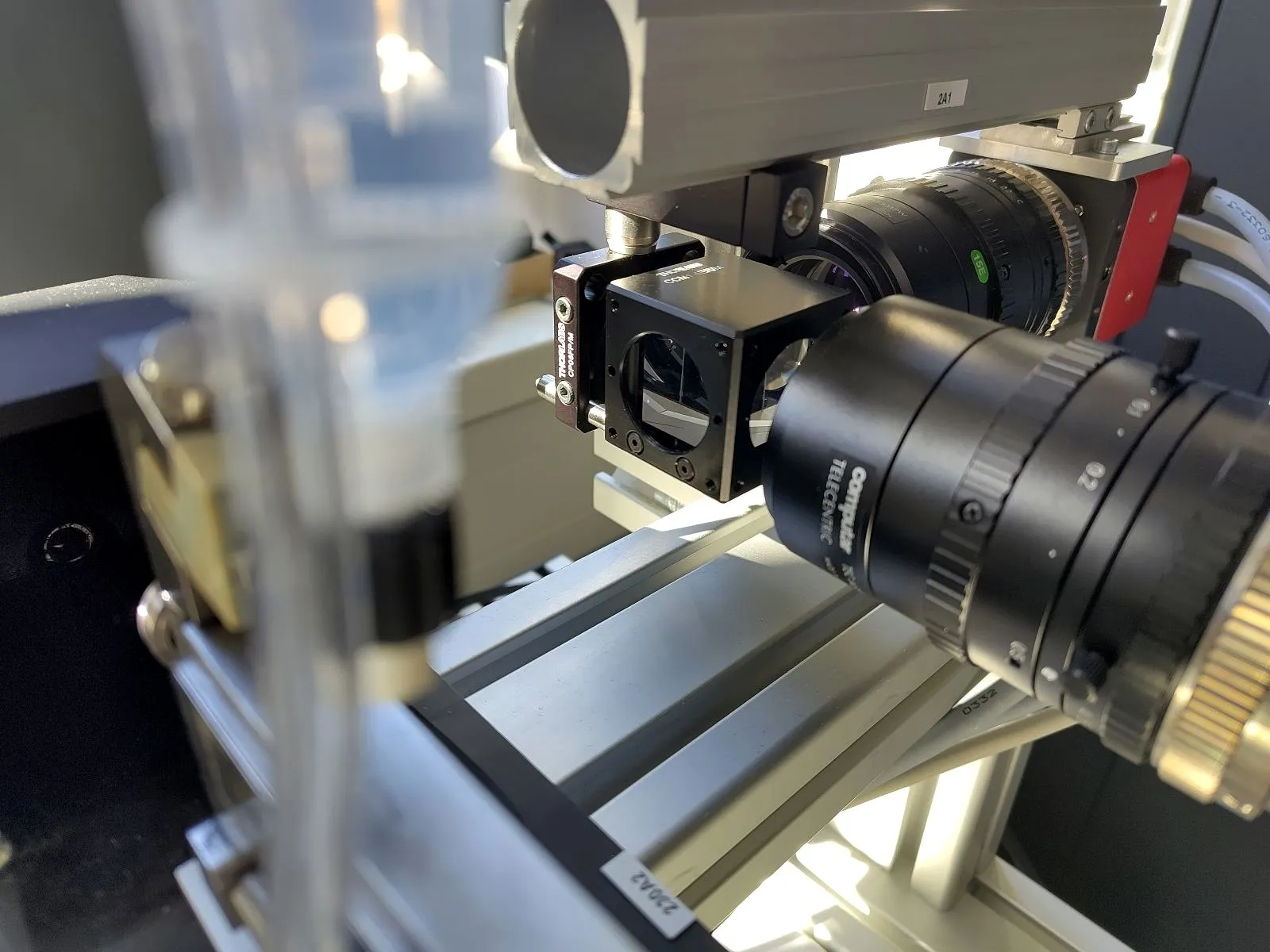
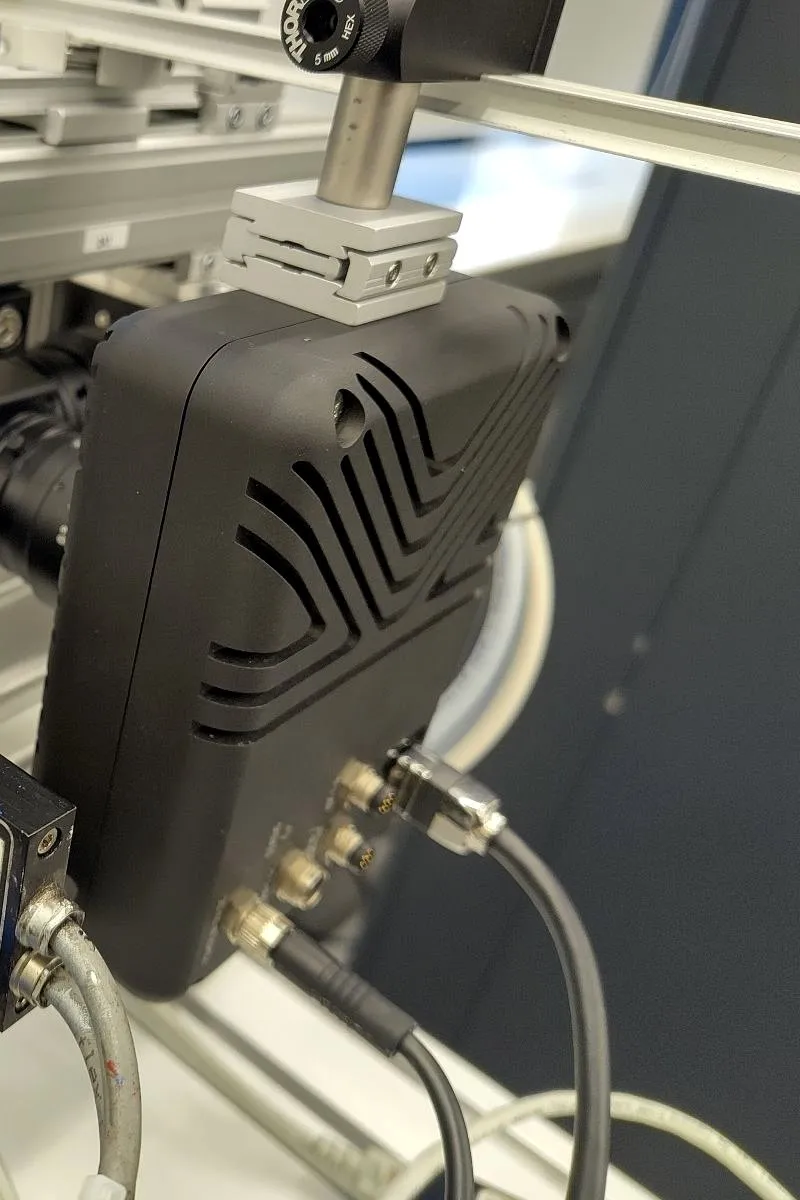
The valve is mounted on a precision XY stage so the camera can be positioned relative to the droplet with sub-millimetre repeatability — the same kind of precision integration work described in HSCAM's engineering & custom integration .
Half two — NANO
Closing the loop, entirely on-chip
Confirmed directly by HSCAM: an HSCAM NANO unit runs alongside the STREAMER camera in this same pipeline, closing the loop in real time.
01
Image-based triggering
NANO triggers directly from image content, not a separate sensor.
02
ROI extraction on the VSoC
The droplet's region of interest is extracted on-chip, on the Vision System on Chip itself.
03
AI classification in the NPU
The extracted region is classified by the neural processing unit inside NANO's microcontroller — no host PC involved.
04
Closed-loop output
NANO's result adjusts the droplet generator directly — closing the loop instead of just logging a result.
This half of the pipeline is described here as confirmed directly by HSCAM. No photo or video of the NANO hardware inside this specific rig exists yet — see HSCAM NANO's own product page for what NANO itself looks like.
Demonstrated Results
What the STREAMER camera actually captures
Real recorded footage from the rig: a backlit droplet, and the smaller satellite droplets that a good frame needs to capture too — exactly what an inspection model has to learn to tell apart.
Droplet and satellite droplets, backlit
- Recorded at
- 8,000 fps
- Image size
- 1,280 × 128 px
- Frame
- Backlit silhouette
- Shows
- Main droplet + satellites
One frame carries a drawn line between two points — an analysis overlay from the capture setup, not added for this page.
Research application — Fraunhofer IIS/EAS Dresden Live view on-screen
Realtime Droplet Inspection — STREAMER training data, NANO closed-loop correction
A compact HSCAM STREAMER camera, backlit through a beam-splitter cube, observes the whole droplet path and captures high-contrast droplet silhouettes to generate an AI training set. An HSCAM NANO unit closes the loop: image-based triggering, on-chip ROI extraction, AI classification in its NPU, and output that adjusts the droplet generator in real time.
- STREAMER role
- Observes the whole droplet path, generates AI training data
- NANO role
- Image-based triggering, on-chip ROI + NPU classification, closed-loop output to the droplet generator
Why HSCAM here
One vendor, from wide observation to on-chip correction
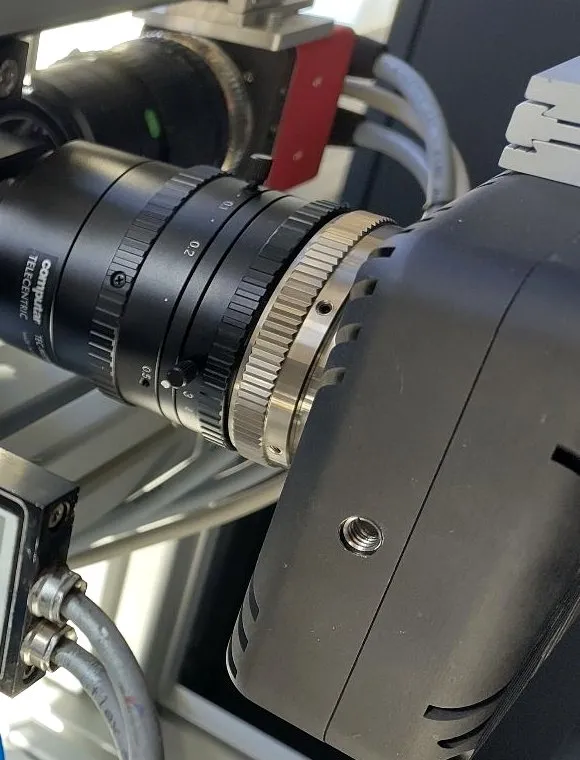
Generating usable training images depends on image quality and how tightly the camera fits a purpose-built optical path. Acting on the result depends on a completely different kind of speed — on-chip, no host PC. HSCAM builds both ends.
Compact housing
Small enough to mount directly on a beam-splitter cube on a shared optical axis, alongside the dispensing hardware it's imaging.
Clean, high-contrast capture
Backlit droplets are captured as sharp silhouettes — exactly the kind of image that's fast to label and easy for a model to learn from.
Closed-loop, on-chip
NANO's on-chip classification and output mean the correction happens without waiting on a host PC round-trip.
Related
More ways HSCAM cameras get integrated
Recognize this problem in your own inspection or research setup?
I have a similar problem →Talk to an engineer about a research or inspection setup
Tell us about your optical path, your object, and what you need the images for.
HSCAM GmbH · Angerstraße 40–42, Haus B · 04177 Leipzig, Germanycontact@hscam.com · www.hscam.com